
An abandoned place, a reminder of our impermanence
Lessons to learn from the collapse of a once-thriving civilization

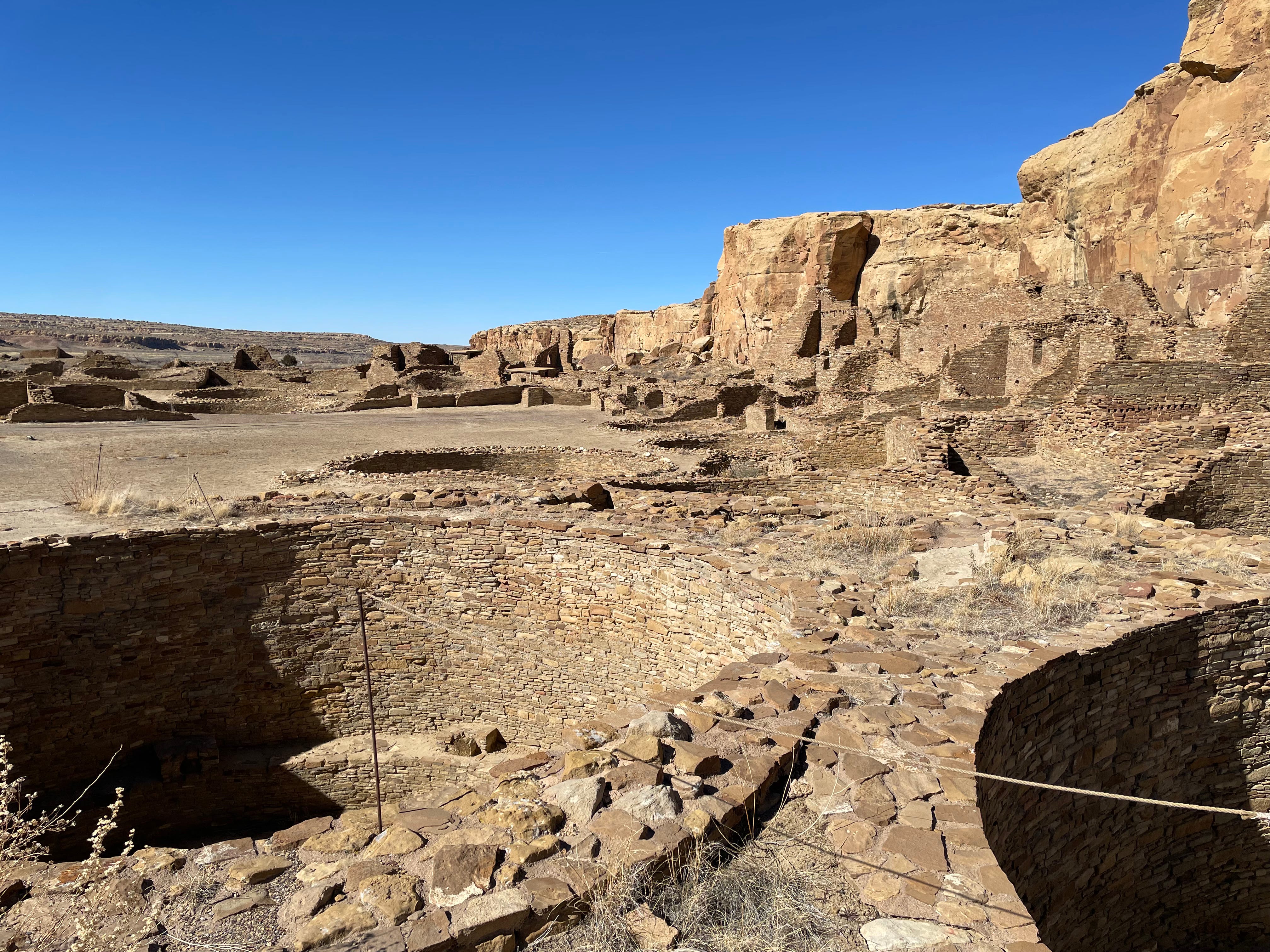
Vestiges of an ancient civilization are visible in the New Mexico desert. Do we recognize the lessons of its demise? (RS photo)
It is humbling to witness the remnants of an almost-vanished culture that thrived a millennium ago. It underscores the notion attributed to Napoleon Bonaparte, arguably the most consequential human in Western civilization during the 19th century: “Glory is fleeting, but obscurity is forever.” How different things might be for us and for our future if the transience of fame and power were understood by today’s self-absorbed leaders — starting with a president who just now is demanding that monuments be raised to glorify him before his power wanes and, indeed, he returns to dust.
Poor Donald Trump, a rich city kid whose parents neglected him. I wish they had taken him to visit the U.S. National Parks that honor our heritage, a cherished gift of my own childhood. He might have learned there some lessons from the history of the continent that he now demands to dominate. Lacking that, his character is awash in arrogance. He equates humility with weakness, rather than embracing it as honest recognition of the limits of our own consequence.
This week, on a bright and unseasonably warm day for January in northern New Mexico, I stood amid the ruins of an all but lost world that was based here perhaps 1,200 years ago. Chaco Canyon is mostly empty now, but humans actually not so different from us once thrived in this place — erecting huge buildings, establishing a complex social organization and developing far-reaching commerce. We had driven 16 miles beyond the end of pavement to reach what was the center of Chacoan culture, now called Pueblo Bonito. The handful of visitors exploring the site alongside us were almost silent, perhaps as awed as we were, sensing the spirits of the lives that once bustled about the place.
As we had turned off the highway, a radio newscast had reported that Trump is holding up $16 billion in federal transportation aid for New York and New Jersey that he will release only if Congress agrees to put his name on both Washington’s Dulles International Airport and New York’s Pennsylvania Station. This came after he confirmed that he wants to quickly build the world’s biggest triumphal arch, at 250 feet tall, just across the Potomac River from the Lincoln Memorial, which is 99 feet tall, and just downstream from the Kennedy Center for the Performing Arts, on which he has affixed his own name above that of the slain 35th president. Only a fool would imagine that such recognition would have any durability.
We turned away from the news of the day as we crossed the high desert valley, its dry brush supporting only a few small herds of cattle. It’s hard to imagine how this place — with its marginal rainfall and sandy soil — might have seemed the right place in the mid-800s for people to begin to build many massive, multi-story stone buildings, each with hundreds of rooms. Over three centuries, Chaco Canyon became an economic and ceremonial center, linked by a road network to hundreds of other settlements.
Today the silent remnants of the elaborate edifices are visited by people who are clearly more curious than our president about the past, and more respectful of its lessons. I visited with my older brother; we’ve both reached an age that regularly requires us to recognize our own mortality. The quiet decay in Chaco Canyon magnifies those thoughts, applying them to a whole society, evoking gratitude for what has been and recognition of its impermanence.
When a culture seems to vanish, leaving behind only traces of its lost glory, you have to wonder: What happened here? Perhaps there were physical factors — a drought, the depletion of crucial resources — or maybe it fell victim to political, social or religious conflicts.
In a nation that seems headed toward epic decline, it’s hard not to wonder if humans centuries or millennia from now will ask the same questions about us: How did so great a society crumble? Chaco Canyon presented the question, but experts’ best guesses about what led to its fate — a half-century of drought, environmental degradation caused by development, violence linked to the scarcity of food and resources — might not apply specifically to America’s case. Or maybe they will.
On a bookshelf in the small visitor center maintained by the U.S. Park Service at Chaco Canyon, there are copies of the 2005 book Collapse: How Societies Choose to Fail or Succeed, by the popular scientist Jared Diamond. Among the cultures explored in the book are those of the Anasazi, the ancestral Puebloan people of Chaco Canyon. Diamond cites five factors that led to collapse of past cultures, and a dozen that face us in the 21st century.
Diamond’s writing was broad in scope, but he was primarily a geographer before his retirement from UCLA in 2024 (he is now 88 years old). Among the collapse-inducing factors Diamond cites, from global data: climate change, hostile neighbors, the decline of essential trading partners, local environmental problems and the political failure of communities to respond to the other challenges. Today societies face added burdens, he notes, including the buildup of toxins in the environment, emerging energy shortages and the increased burden on the environment of each human (such as the magnified burden of humans using cars compared to horses for transportation).
Do we imagine that any of those challenges are not facing America today? The president seems unaware. “We’re the hottest country anywhere in the world,” Trump bragged in December, “and that’s said by every single leader that I’ve spoken to over the past five months.” A year before, he said it was a “dead country.”
Near the book’s end, Diamond notes “that a society’s steep decline may begin only a decade or two after the society reaches its peak numbers, wealth, and power.” Yet the book is not without hope. He points to societies that have survived challenges that disabled others, citing the key importance of leaders’ breadth of vision — that is, “the courage to practice long-term thinking, and to make bold, courageous, anticipatory decisions at a time when problems have become perceptible but before they have reached crisis proportions.”
Danger rises, Diamond says, when the short-term interests of elite leaders conflict with the long-term interests of a society, and the elite are insulated from the direct consequences of their decisions.
Standing by the bookshelf in Chaco Canyon, reading Diamond’s warning, it was hard not to feel a sense of dread. Did some of the people who once thrived in this place worry, as we do now, that their leaders didn’t understand the consequences of their actions, or that they didn’t care because they wouldn’t be as affected by them as others are? Did they raise their voices before their world collapsed?
Many of the indigenous tribes of the American Southwest are Chaco descendants, anthropologists tell us, so the place has great significance in the history of people who live in the so-called Four Corners region of America today. So the culture of the Chacoans didn’t vanish, in fact, even though Chaco Canyon was abandoned between roughly 1100 and 1350.
In the Eurocentric history classes of my youth, I learned that those years were a period of prosperity and growth on the continent that came to colonize America with white people. Then came the Great Famine of 1315-1317 and the “Black Death” of 1347-1353, which together reduced the European population to about half of what it had been, and killed one-third of the population of the Mideast. Centuries of social unrest and endemic warfare followed.
Science hadn’t advanced enough at that time anywhere in the world to combat the pandemic of the Black Death, a bacteria apparently spread by fleas and through the air. Nor were transnational political organizations in place to mediate the disputes that led to bloody warfare through generations. Decline was thus almost inevitable.
We’re lucky today, then, aren’t we? When resources were marshaled to quickly create a vaccine to combat Covid, we were able to mostly overcome what could have been a pandemic as destructive as the Black Death. Science likewise reduced the devastation of AIDS, and political leadership delivered healing resources throughout the world — notably through the greatest effort to combat disease in history, the U.S. President’s Emergency Plan for AIDS Relief (PEPFAR), which has saved 26 million lives globally.
Against that backdrop, consider what Donald Trump and his enablers are doing. Trump has withdrawn the U.S. from 66 international entities, including the World Health Organization, the Paris climate accords and 31 United Nations organizations. America’s top health and science official, Robert F. Kennedy Jr., is downplaying vaccines and other life-saving strategies, an abandonment of scientific consensus in favor of discredited superstitions that put future generations at risk. The administration has halted funds for the global HIV/AIDS program and killed the U.S. Agency for International Development, putting millions of lives at risk. Trump’s key adviser Stephen Miller told CNN last month that global cooperation amounts to no more than “international niceties,” and that Trump recognizes that “strength, force and power” are the “iron laws of the world.”
Actually, of course, the iron law of the world is our own impermanence. In places such as Chaco Canyon, where empty and decaying structures under a shocking blue sky underscore the reality of our fleeting presence, we are reminded that we ought not to be so reckless with our temporary power, and why, then, we must so relentlessly work to replace our short-sighted and cocky leaders with people who recognize that we aren’t, in fact, exempt from nature’s rule, and that we must then cherish our temporary stewardship of this place. Our society’s survival depends upon it, as the wind rustling the empty dry range of America’s high desert reminds us so well.
WHY NOT TELL YOUR TRUTH?
LEARN TO WRITE OP-EDS — FOR PRINT, AUDIO AND PODCASTS
If you’d like some training in writing opinion essays — for newspapers, audio or digital platforms — check out the live 90-minute class Rex co-teaches that is offered by Marion Roach Smith’s global platform for writing instruction, The Memoir Project. Click below for information on our upcoming schedule of classes.
Our next class is WEDNESDAY, FEB. 18 at 5:30 p.m. Eastern.
Will you join us?
Lots of our students have been well published — and you can be, too!
BONUS CONTENT
GET MORE FROM THE UPSTATE AMERICAN
IF YOU’D LIKE TO HEAR MORE from Rex Smith, check www.wamc.org for his weekly on-air commentary aired by Northeast Public Radio. Here’s a link to the latest essay.
AND IF YOUR INTEREST IS SPECIFIC TO AMERICAN MEDIA, you can download the podcast of The Media Project, the 30-minute nationally-syndicated discussion that Rex leads each week on current issues in journalism. In the seven states where Northeast Public Radio is heard, the program airs at 3 p.m. each Friday and is rebroadcast at 6 p.m. Sunday. You can tune in live, too, at www.wamc.org, or download the podcast there. It has been called “a half-hour of talk about finding and telling the truth.”
WITH GRATITUDE
THE UPSTATE AMERICAN is a weekly essay aimed at helping all of us who are concerned about America’s future consider how we might best respond to the challenges of the day. Thank you for joining in the conversation about our common ground, this great country. I hope you’ll be back next week.
And don’t hesitate to send your thoughts, especially with ideas that you think we all ought to be considering.
-REX SMITH
We don’t learn from the past. We alter it to fit our personal need. This is how we fail culturally.
“To accept one’s past – one’s history – is not the same thing as drowning in it; it is learning how to use it. An invented past can never be used; it cracks and crumbles under the pressures of life like clay in a season of drought.”
- James Baldwin
I met a traveller from an antique land,
Who said—“Two vast and trunkless legs of stone
Stand in the desert. . . . Near them, on the sand,
Half sunk a shattered visage lies, whose frown,
And wrinkled lip, and sneer of cold command,
Tell that its sculptor well those passions read
Which yet survive, stamped on these lifeless things,
The hand that mocked them, and the heart that fed;
And on the pedestal, these words appear:
My name is Ozymandias, King of Kings;
Look on my Works, ye Mighty, and despair!"
Nothing beside remains. Round the decay
Of that colossal Wreck, boundless and bare
The lone and level sands stretch far away.
This Shelley poem and the paintings in Thomas Cole's Course of Empire keep flitting through my head on a regular basis. And have done for about 10 years now.
: /