
Coping with reality by turning away
An impending slow-motion Dust Bowl presents the peril of ignoring risks

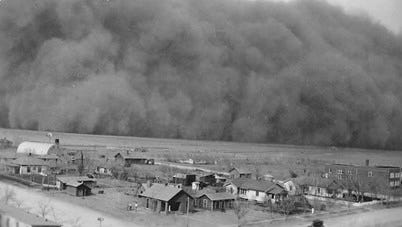
A dust storm approaching Rolla, Kansas, May 6, 1935 (Photo: NDMC)
Severe drought gripped the upper Great Plains the year that my father uprooted our family from the Midwest and drove us across parched prairies toward our new home in South Dakota’s Black Hills. I was 8 years old, hearing things I didn’t quite understand — about pastures failing and stock ponds drying up, and ranchers being forced to market their skinny cattle early because they couldn’t water or feed them. I heard old-timers warn that we might be witnessing a return of the Dust Bowl calamity of the 1930s, when entire communities vanished as their residents fled the scorched earth, thousands of people died, and two million people were left homeless.
In our time, we were luckier. After a couple years of distress, normal weather patterns resumed, apparently making the land useable again for crops and grazing. Now we look at 90-year-old photos of the disaster that hollowed out huge stretches of mid-America and — in those rare moments when we think at all about how our food is produced — we are grateful that modern agricultural practices seemingly protect us from a similar disaster. Such techniques as contour plowing and cover cropping have reduced soil erosion by about two-thirds from the 1930s, agriculture experts say.1
But stubborn humans are often served up harsh and necessary reminders of how prone we are to delusion. This winter has presented a “snow drought” in much of the Great Plains, adding little moisture to soil already depleted by years of rising temperatures. It worries people who realize this reality: The recovery of American agriculture since the Dust Bowl years is based less on rainfall’s return than on the crutch of irrigation. Unlike the 1930s, 90 percent of the Great Plains is watered these days by tapping the Ogallala Aquifer, a massive water source beneath eight states that was formed millions of years ago.2
Today we are drawing down the aquifer at least 10 times faster than it can naturally recharge. The deep humus-rich topsoil that was lost in fierce Dust Bowl windstorms has not, in fact, regenerated; in many areas, the soil is thinner and more vulnerable than it was a century ago. Scientists warn that across vast parts of the country, we are merely managing the land to depletion — a slow-motion Dust Bowl for the 21st century.3
Don’t blame the farmers and ranchers who are doing what they can on land that they know is in their custody for the short term of a generation. In fact, I’d suggest you go find yourself a farmer to thank for their service, with the same reverence that people these days tend to offer someone in a military uniform. But no more than we would send troops into battle without checking the stockpile of ammunition should we ignore the toll agricultural production has taken on the earth. Turning away from reality isn’t a strategy for coping with it, after all. “Facts do not cease to exist because they are ignored,” Aldous Huxley wrote.
This is how we tend to deal with all sorts of matters that confront us — or, really, how we avoid dealing with them. You could blame our genetics: For most of human history, worrying about long-term threats or opportunities was an unaffordable luxury, since a saber-toothed tiger might be lurking in a nearby cave. But what you might call “short-termism” fails us in modern life, and it marks a moral failure on our part. After all, an understanding of history and science makes it possible for us to know these days what we’re likely doing wrong and how we might make life better for ourselves and our children’s children.
One of the reasons humans established the structures of society — governments, religions, communities, families — was to enable us to marshal the will to do what needs to be done. Throughout history, leaders have been elevated based on their foresight and their capacity to motivate people to make the smart choices that will protect and enhance lives. It is when leaders turn away from those hard but smart choices that societies begin to crumble.
And that is the underlying peril of the course America is on under the leadership of Donald Trump and his enablers. The Trumpists — members of his administration loyal to Trump over all else, Republicans in Congress who now blithely go along with policies they once more wisely opposed, private sector leaders whose greed prompts them to kowtow to White House whims — are encouraging us to be deluded by the comfort of intentional ignorance.
You would think somebody in that crowd would shudder at the irony of how antithetical this is to the core message of the modern right wing’s intellectual progenitor, Ayn Rand. In her seminal 1961 essay “The Objectivist Ethics,” Rand wrote: “[Man] is free to evade reality, he is free to unfocus his mind and stumble down any road he pleases, but not free to avoid the abyss he refuses to see.” Or, as the Rand notion is often paraphrased, we’re free to avoid reality, but not free to avoid the consequences of avoiding reality. Ignoring a pending crisis has never been a good way of coping with it.
Eventually, reality triumphs. Always. We can rebuild from the consequences suffered by ignoring its forward march, but that’s often a more difficult path than the road that would rise to meet us if we were to choose to confront head-on what’s real.
For example: It is simply not possible that most Republican members of Congress don’t recognize how preposterous is Trump’s insistence that he was cheated out of re-election in 2020, though his wins in 2016 and 2024 and the votes to give Republicans control of Congress were somehow fair and square. Yet where is the Republican pushback, then, to Trump’s threat to “nationalize” the election process, perhaps by presidential decree, in order to eliminate this non-existent voter fraud? What price of integrity is being paid for not calling out Trump’s narcissistic blather now — and what effort will someday be needed to restore confidence in American democracy?
Likewise, the reality of Trump’s assault on the rule of law is clear, but ignored by his partisans at great long-term cost. Federal judges are finally getting tough in the face of the administration’s willful disregard of their lawful orders: This week the chief federal judge of Minnesota (named to the bench by President George W. Bush) identified 210 orders in 143 cases in which Immigration and Customs Enforcement officers have not complied with court orders. On the same day, in New Jersey, a federal judge cited “intentional misconduct” by federal prosecutors and insisted, “It ends today.” And last week, a California judge complained about “unlawful, wanton acts by the executive branch.” Where were the objections of Trump partisans as they witnessed the lawless behavior that led up to those rulings?
What Republicans pushed back when the president used unusually personal terms to attack the Supreme Court majority that ruled against his tariffs? He said he was “ashamed” of the high court justices, that they were “disloyal,” “an embarrassment to their families” and “swayed by foreign interests.” What effort might today’s cowardly backers of Trump someday suggest might be undertaken to restore Americans’ confidence in the integrity of our judicial system? Will they be scrounging pennies’ worth of votes to pay the repair bill for American democracy, or are they willing to tolerate its bankruptcy under the stewardship of a morally profligate president?
Most obvious, of course, is the turn away from science represented in Trump’s squelching of all efforts to combat climate change. Citing “beautiful coal,” complaining that wind energy is “ugly” and “disgusting,” and claiming that the climate crisis is a “hoax,” Trump is turning back the clock to a more ignorant time, as shockingly as if a modern president were to launch initiatives to subsidize cigarette production.
Someday, of course, there will be another president who will face the reality of climate change. What will we have lost in the meantime, as Trumpist Republicans pursued the short-term objective of supporting their president at the long-term expense of the nation’s stability and health?
The 1930s drought that caused the Dust Bowl was a natural event, but the disastrous impact was driven by ignorant human activity. Between 1910 and 1929, the Great Plains experienced unusually high rainfall, leading farmers — at the urging of land speculators — to borrow money to buy land and put it under cultivation. Some pseudo-scientists put forward the notion that “Rain Follows the Plow,” suggesting that breaking prairie sod would enable the soil to absorb more moisture, which would then evaporate and cause more rain to fall.4
Thousands of farmers responded by heading West. They tore out the deep-rooted prairie grass that had survived wet and dry cycles for millennia, planting instead shallow-rooted wheat and corn crops that withered when the wet cycle ended. The intensive tillage led to powder-fine soil that blew away in the hot wind. Countless families lost their land; many people lost their lives to “dust pneumonia,” after inhaling silt that acted like pulverized glass in their lungs.5
There have been efforts to heal the land since then, but the process is incomplete. To replace the failed grain crops of the 1930s, the government has incentivized farmers to plant native shortgrass prairie for cattle grazing. Organizations like The Nature Conservancy are working to conserve intact grasslands and restore millions of acres. But those initiatives fall short, and vast reaches of western lands are under what might be considered fragile cultivation: dependent on capital-intensive irrigation from diminishing water sources that is subsidized by the federal government.6
It is a dubious policy. The drawdown of the Ogallala Aquifer means that we have essentially traded the soil crisis of the 1930s for a water crisis in the 2020s. That is, the lack of rain today has led us to “borrow” water from the past. And since the beginning of this century, virtually the entire western United States has been gripped by drought; from 2000 to 2021, parts of the Southwest were in a “megadrought,” marking the driest period in at least 1,200 years.7 Scientists say human-caused climate change, with higher temperatures leading to more evaporation, is sharply increasing drought’s severity and making decades-long drought more likely.
So we are near a breaking point. And with the Trump administration’s hostility to climate issues — its aversion to long-term solutions and focus on politically-charged crisis management — there is no prospect for turning around the damage and reducing the risk anytime soon.
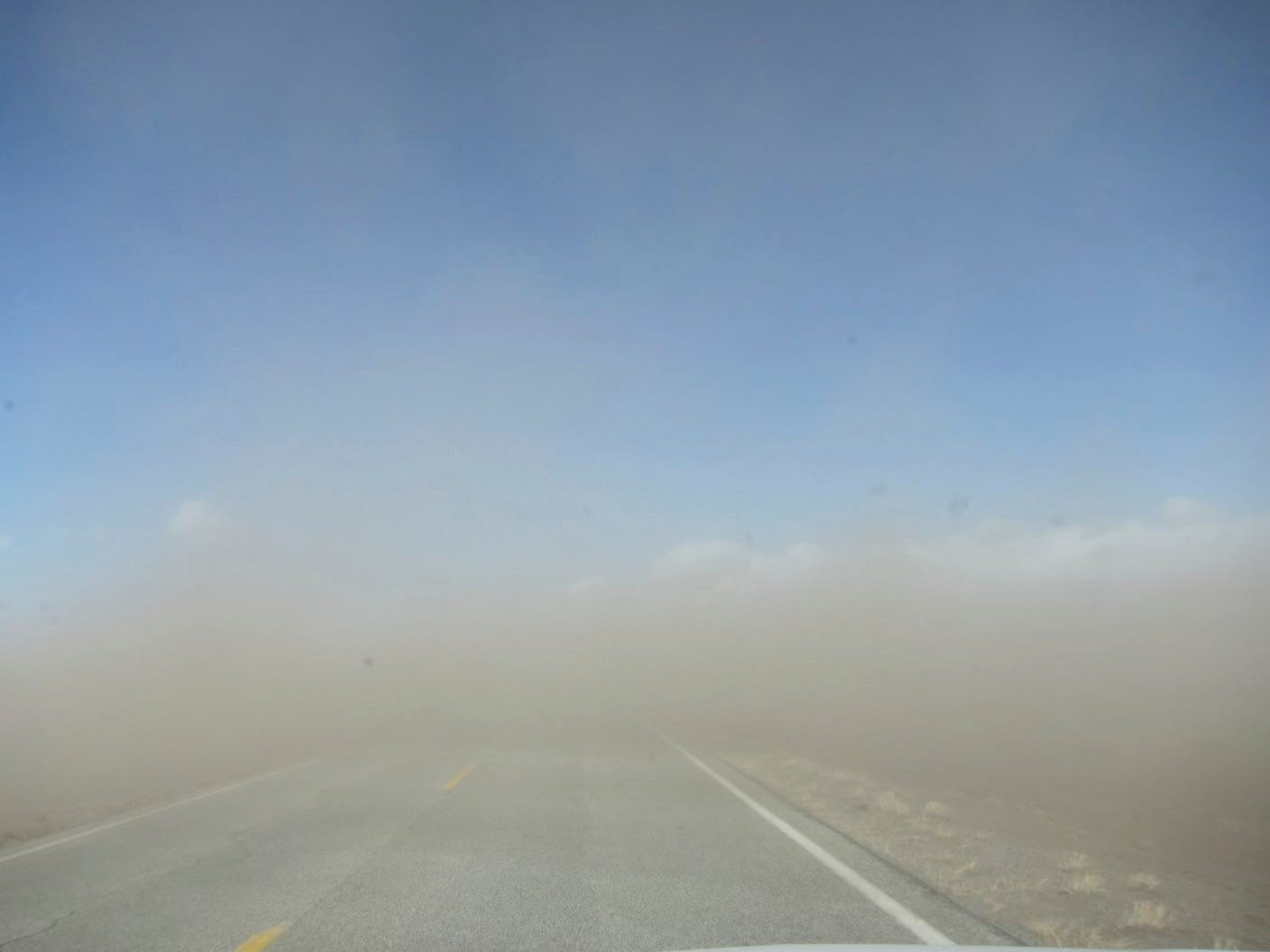
I have experienced a terrifying glimpse of the future. As we drove across the Oklahoma panhandle during a dry spring many years ago, an intense dust storm suddenly blew up. Like a blizzard in winter, the swirling brown dirt made it impossible to see more than a few feet in front of the car. Yet the fear of being rear-ended on the roadside led us to shut off the air conditioner and keep going, ever so slowly. The air in the car was hot and tense. After perhaps a half-hour, we emerged into dull sunlight.
Our discomfort was brief, then, but the memory has lingered as a reminder of our vulnerability to nature. Of course, if dust storms enveloped us regularly, we surely would respond to that immediate risk, given the survival-focused wiring we have inherited from the Pleistocene era. But the reality of too little water in vast reaches of the nation is one of those long-term, abstract threats that we tend to meet mostly with a shrug.
That will likely be our reaction until the Dust Bowl returns — or until leadership capable of long-term thinking is restored to America.
https://abqstew.com/2023/04/04/parallels-to-the-past-a-comparison-of-the-dust-bowl-era-soil-health-to-modern-day-farming-practices-and-soil-health/
https://www.usda.gov/about-usda/news/blog/nifa-impacts-saving-ogallala-aquifer-supporting-farmers#:~:text=The%20Ogallala%20Aquifer%20is%20one%20of%20the,underlies%20175%2C000%20square%20miles%20in%20eight%20states.
https://e360.yale.edu/features/as-the-climate-warms-could-the-u.s.-face-another-dust-bowl#:~:text=Improved%20agricultural%20practices%20and%20widespread,%2D%20and%20carbon%2Drich%20topsoil.
https://archive.ph/20120911070524/http://www.pbs.org/weta/thewest/program/episodes/seven/rainfollows.htm
https://www.cbsnews.com/news/dust-bowl-heat-wave-climate-change-twice-as-likely-study-says/
https://www.pbs.org/newshour/nation/farmers-restore-native-grasslands-as-groundwater-disappears#:~:text=Some%20are%20growing%20crops%20that,hard%20here%20with%20no%20water.%22
https://www.drought.gov/current-conditions#:~:text=Drought%20worsened%20in%20every%20state,Week%20Change%204%2DWeek%20Change
Note: Comments on The Upstate American’s website are open to paying subscribers. We are grateful to all our readers, and invite you to join in supporting this work.
WHY NOT TELL YOUR TRUTH?
LEARN TO WRITE OP-EDS — FOR PRINT, AUDIO AND PODCASTS
If you’d like some training in writing opinion essays — for newspapers, audio or digital platforms — check out the live 90-minute class Rex co-teaches that is offered by Marion Roach Smith’s global platform for writing instruction, The Memoir Project. Click below for information on our upcoming schedule of classes.
Our next class is MONDAY, MARCH 9, at 6 p.m. Eastern.
Lots of our students have been well published — and you can be, too!
BONUS CONTENT
GET MORE FROM THE UPSTATE AMERICAN
IF YOU’D LIKE TO HEAR MORE from Rex Smith — specifically, his take on current issues in American journalism — you can download the podcast of The Media Project, the 30-minute nationally-syndicated discussion that Rex leads each week with other veteran editors. In the seven states where Northeast Public Radio is heard, the program airs at 3 p.m. Eastern each Friday and is rebroadcast at 6 p.m. Sunday. You can tune in live, too, at www.wamc.org, or download the podcast there. It has been called “a half-hour of talk about finding and telling the truth.”
ENDNOTE
THANK YOU FOR JOINING US THIS WEEK
THE UPSTATE AMERICAN is a weekly essay aimed at helping all of us who are concerned about America’s future consider how we might best respond to the challenges of the day. Thank you for joining in the conversation about our common ground, this great country. I hope you’ll be back next week.
And don’t hesitate to send your thoughts, especially with ideas that you think we all ought to be considering.
-REX SMITH
Words fail me when I survey the damage that the few are doing to the many and the earth. We are leaving a bitter legacy that will be difficult for our children and grandchildren to reverse.
What fools.