
How Costco reveals Trumpism's vulnerability
Being true to your values might be what voters are looking for in 2026

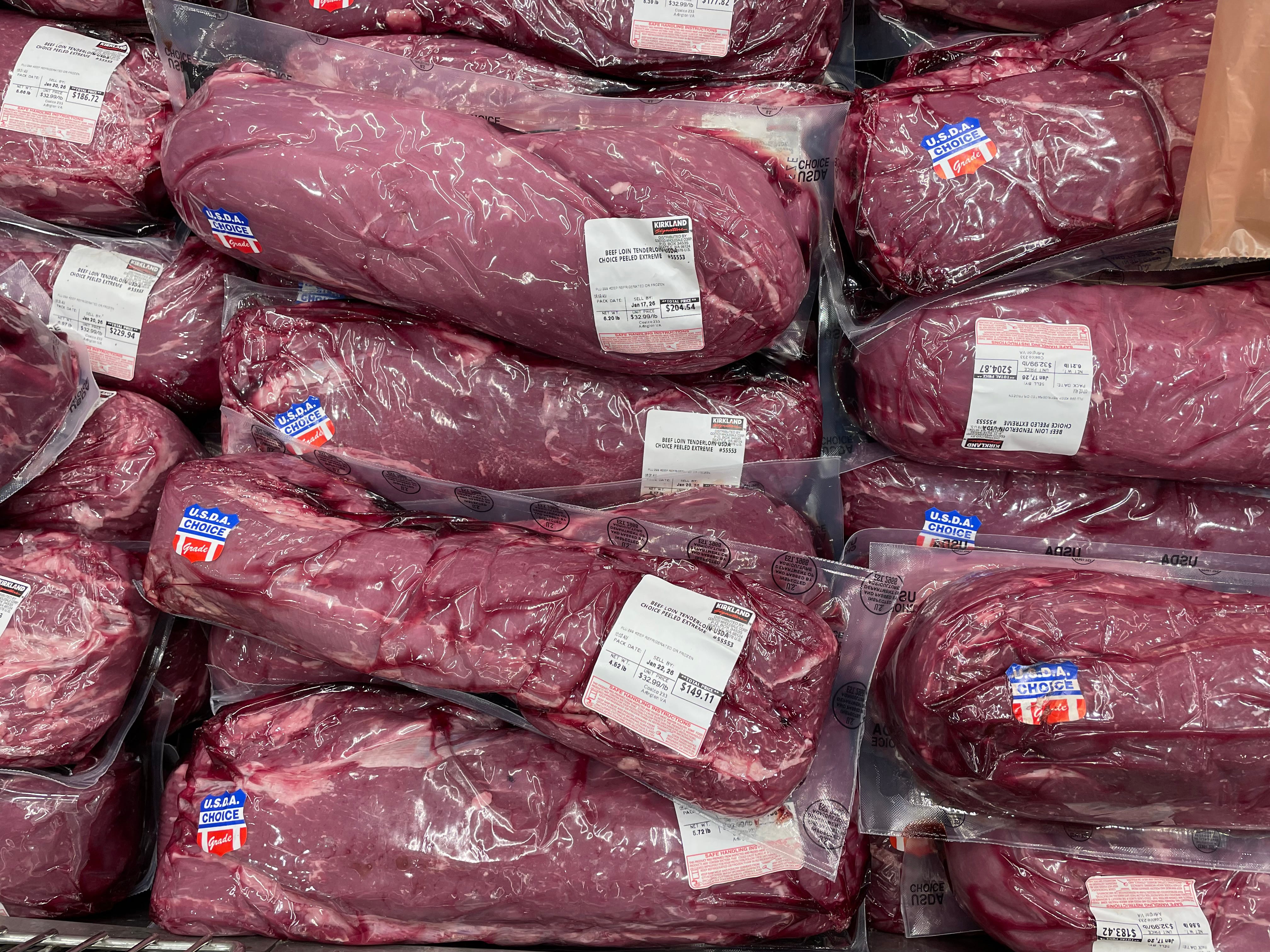
Costco sells more paper products than beef, but the sense of abundance is part of the brand. (RS photo)
Until last week, I hadn’t ever shopped at Costco, so I didn’t have firsthand experience with the buck-fifty hot dog/soda deal, the bulk buys of paper products at cut-rate prices (a billion rolls of toilet paper sold each year!) or the whole rotisserie chicken that’s cheaper than Cheerios at your ordinary supermarket. On my first visit, to a cavernous Costco just outside Washington, D.C., I turned around from a pile of organic kapok-filled pillows promising optimal spinal alignment and found myself facing a giant cooler of huge beef tenderloins. Those big packs of protein were uncommonly alluring, but I wasn’t in the market for meat, so I settled for a photo that would memorialize my first encounter with a place that is surely a marketing marvel.
There’s more to this phenomenon than shopping, I half-realized. Something about it stood out in relief from what we’ve come to expect in Donald Trump’s America, but I needed to think about it, and do some reporting, to figure out what made the place so compelling. Maybe I felt fondness for the company because I remembered that Costco had refused to backtrack on its commitment to diversity, despite Trump’s pressure, or maybe it was because last month Costco sued the administration for a refund of what it has spent on Trump-imposed tariffs. You know, the enemy of my enemy, et cetera.
There was a big piece about Costco in The New Yorker a couple of months ago — “just about everyone loves Costco,” writer Molly Fischer’s article asserted — but that felt to me like a review of a TV show almost everybody but you has seen, because our home is in that diminishing part of America that is still Costco-free.1 That situation will change later this year when Costco opens a 163,000-square-foot warehouse (the company does not call it a “store”) that is now under construction in a nearby suburb. People who live near the site are upset by construction noise and the prospect of traffic congestion, but most everybody else in the region seems pretty excited about the coming of the brand.
In that, Upstate America is not alone. In a corner of North Carolina that is home to the Great Smoky Mountains, a news site noted last week that the local story generating the most reader engagement in 2025 was the prospect of Costco opening a store in Asheville. Never mind all the fine investigative reporting that the appropriately-named Asheville Watchdog publishes, columnist John Boyle wrote, because “City Council will likely engender rioting in the streets if it sends Costco packing.” Asheville politicians are forewarned.2
Marketing experts say Costco counts one-third of Americans among its shoppers, which sounds huge until you consider the retail reach of WalMart, which boasts that 90 percent of U.S. households regularly “rely on” its stores. But there are only about 630 Costco outlets in the country, compared to some 4,600 WalMarts, so it’s kind of like comparing your favorite seafood restaurant to Red Lobster.3
What seems to make people so loyal to Costco, I’ve pretty much concluded, is something that’s often hard to find in business, as it is in politics, namely, authenticity. It’s not that the shareholders of Costco aren’t just as keen for profit as the people who buy WalMart stock; it’s that the smaller company seems more committed to an approach that reflects historic American business tenets, and it knows exactly what it’s doing. It’s true to its values, even in the face of challenge.
In that there may be a lesson for the people who want American politics to move along from Trumpism — a majority of us now, it seems, with the president’s job approval rating hovering below 40 percent in credible polls. Costco’s success might make you wonder how long this Trump nightmare can really continue. No wonder I felt good about my first encounter with Costco: It may be showing us a way out of this mess.
Political polarization has increasingly affected Americans’ purchase decisions since Donald Trump’s election in 2016, according to research from the Columbia University Business School. In a 2023 paper, Columbia marketing experts reported that 80 percent of consumers believe that brands have political affiliation, and six in 10 Americans say they would boycott (or “buycott”) a brand based on their own political identity. This impulse was stronger for liberals than for conservatives, the researchers reported.4
It’s not that conservatives don’t jump into market pressure campaigns. Notably, Bud Light beer was hammered with a boycott in 2023 after it undertook a social media promotion with a prominent transgender influencer. Marketing experts say that Anheuser Busch was vulnerable to the Bud Light boycott because competitors could easily replace the product: Bud Light is arguably the least memorable beer ever brewed. Customers had no reason to be loyal. The brewer’s swift retreat only put wind in the sails of the boycotters while angering the left.5
That boycott drew support from right-wing politicians, but it’s rare that the government itself has stepped into consumer campaigns — until now. Republican politicians, after all, have traditionally voiced respect for free market economics, but the whole party has clammed up at Trump’s blatant interference into commerce.
Notably, as Trump demanded the end of diversity, equity and inclusion programs — not just in government, but in private business — many of even the nation’s biggest and most successful businesses quickly caved in, including Amazon, Meta, Pepsico, McDonald’s, Target and WalMart. Some consumers pushed back: After Target announced changes to its DEI policies, there was a noticeable drop in foot traffic.
But Costco has held firm. When a right-wing advocacy group demanded an end to the company’s DEI policies, more than 98 percent of shareholders voted against the proposal. “We owe our success to the more than 300,000 employees who serve our members every day.” CEO Tony James said then. “It is important that they all feel included and appreciated and that they transmit these values to our customers.”6
Likewise, the CEO has been clear about the company’s efforts to hold the line on prices despite the impact of Trump’s tariffs. In its lawsuit demanding payment — which would help the company in the event the Supreme Court rules that Trump imposed the tariffs unconstitutionally — Costco attacked “the pell-mell manner by which these on-again/off-again” tariffs were “threatened, modified, suspended and re-imposed, with the markets gyrating in response.”
Interestingly, there has been relatively little evident consumer response from pro-Trump consumers. Perhaps that’s because the tariffs aren’t popular anywhere: One poll shows that Americans by a 2-to-1 margin believe their impact has been negative so far. And David Primo, a professor of the University of Rochester — where a Costco has operated for a decade — told USAToday’s Jessica Guynn that the “fiercely loyal” Costco consumer base wouldn’t be swayed. “Boycotting Target is easy. Boycotting Costco would require a lifestyle adjustment for many,” he said.7
That is, Costco has established a certain integrity that its customers recognize and value. As Paul Argenti, a professor of corporate communications at Dartmouth University’s Tuck School of Business, told USAToday, “Costco knows who they are, they have a strong set of values and they are sticking to them. In the end, they are going to be rewarded for that.”
At a time when Trump’s opponents are struggling to figure out the approach that might sway voters, then, there’s evidence of a lesson in simply holding true to one’s values. Ralph Waldo Emerson, whose advocacy for a life centered on individualism would surely conflict with today’s consumerism, offered an observation that could be of value to those who want to sell things, whether in stores or polling places: “To be yourself in a world that is constantly trying to make you something else is the greatest accomplishment.”
Politics is like retailing, really: Selling a product to a consumer isn’t so different from convincing a voter to support a candidate. They use similar tactics, including targeted messaging and sophisticated branding; they both create narratives in an effort to gain market share. Politicians’ rallies are like retailers’ product launches, with the goal of building beyond that to create a strong and loyal following — among voters or shoppers — who will stick around through changing trends, often due to an emotional connections. Retailers and politicians alike must offer a product (or a candidate) that meets a need.
But to win in the marketplace, both retailing and campaigning need a message that is perceived as authentic. It’s worth noting that the Costco rotisserie chicken is a loss leader at $4.99 — a price it has maintained for years — but one that builds loyalty among lower-income consumers who will find their other needs met elsewhere in the store. The no-frills retailer thus reinforces its image with a genuine bargain, especially among those who need to feed a family for five bucks.
There’s irony, many political observers have noted, in Donald Trump’s ability over three national campaigns to convince tens of millions of voters that he is an authentic voice when, in fact, he is demonstrably the most prodigious and shameless liar ever to appear on the political stage. Glenn Kessler, who was the tireless fact checker at The Washington Post, documented 30,573 lies or misleading statements during Trump’s first term, an average of 21 each day. The editors of PolitiFact, who for 15 years have sorted through politicians’ statements to find the most egregious perfidies, decided that 2025 was unique, and labeled it “The Year of the Lies,” because, in the words of editor-in-chief Katie Sanders, “the volume and severity of the inaccurate claims was just overwhelming.”8
The concern, Sanders said, is that Americans may already care less about what’s true. “We worry that people are too numb to the drumbeat of misinformation,” she told PBS NewsHour. “They have tuned it out.”
Yet there are unmistakable signs that voters are ready for a new approach as the Trump show wears thin. Voters’ experiences, after all, belie the Trump claims: Grocery prices aren’t going down, in fact; the sticker shock of Republican-forced rising healthcare costs is just now being felt by tens of millions of Americans; farmers know that Trump’s tariffs destroyed their foreign markets, and that the $12 billion bailout this year won’t help them next year, as America’s former customers continue to trade with other nations; and nobody is buying the argument that we are blowing fishing boats out of the waters off South America and killing the shipwreck survivors because of the drug trade. Even a Fox News poll concluded that just 15 percent of Americans say Trump’s policies are helping their financial situation, compared to 46 percent who say they’re hurting — undercutting the president’s credibility as he claims to be helping people.
So Emerson’s argument for authenticity — “to be yourself in a world that is constantly trying to make you something else” — is perhaps the best option for those who want to bring an end to Trumpism. New York City elected a socialist mayor, for example, even though polls show that more voters there are comfortable with capitalism than socialism; the difference, arguably, was that voters perceived Zohran Mamdani as an honest broker of information who would pursue the goals he promised.
Just as customers are eager for a retailer they trust to deliver products they want, American voters crave candidates whose stances speak to their needs and, importantly, whose values they can embrace. Standing firm may emerge as the defining difference among candidates seeking support from voters weary of cynical manipulation. As midterm elections get underway, those in the political arena could learn lessons from the unique retailer with the buck-fifty hotdogs and piles of paper products.
https://www.newyorker.com/magazine/2025/10/27/can-the-golden-age-of-costco-last
https://avlwatchdog.org/the-year-in-review-sure-there-were-more-important-issues-around-here-in-2025-but-nothing-electrified-readers-like-costco-news/
https://corporate.walmart.com/news/2022/03/30/walmart-connect-building-meaningful-shopping-experiences-between-suppliers-our-customers#:~:text=The%20meaning%20of%20meaningful%20connections,or%20discover%20a%20new%20one.
https://business.columbia.edu/faculty/research/frontiers-polarized-america-political-polarization-preference-polarization
https://hbr.org/2024/03/lessons-from-the-bud-light-boycott-one-year-later
https://www.usatoday.com/story/money/2025/01/23/costco-dei-shareholder-proposal-rejected/77907655007/
https://www.usatoday.com/story/money/2025/12/10/costco-suing-trump-tariffs/87692798007/
https://www.pbs.org/newshour/show/why-politifact-has-labeled-2025-the-year-of-the-lies
START THE NEW YEAR WITH A WRITING INITIATIVE
LEARN TO WRITE OP-EDS — FOR PRINT, AUDIO AND PODCASTS
If you’d like some training in writing opinion essays — for newspapers, audio or digital platforms — check out the live 90-minute class Rex co-teaches that is offered by Marion Roach Smith’s global platform for writing instruction, The Memoir Project. Click below for information on our upcoming schedule of classes.
Our next class is TUESDAY, JAN. 13 at 1 p.m. Eastern.
Why not join us?
Lots of our students have been well published — and you can be, too!
BONUS CONTENT
GET MORE FROM THE UPSTATE AMERICAN
IF YOU’D LIKE TO HEAR MORE from Rex Smith, check www.wamc.org for his weekly on-air commentary aired by Northeast Public Radio. Here’s a link to the latest essay, which is an earlier version of this week’s column, adapated for audio.
AND IF YOUR INTEREST IS SPECIFIC TO AMERICAN MEDIA, you can download the podcast of The Media Project, the 30-minute nationally-syndicated discussion that Rex leads each week on current issues in journalism. In the seven states where Northeast Public Radio is heard, the program airs at 3 p.m. each Friday and is rebroadcast at 6 p.m. Sunday. You can tune in live, too, at www.wamc.org, or download the podcast there. It has been called “a half-hour of talk about finding and telling the truth.”
THANK YOU for reading The Upstate American, and for joining us in the conversation about our common ground, this great country. I hope you’ll join us again next week — or send a message with ideas you’d like to see us address.
-REX SMITH
Excellent report, Rex.
Anecdotally, I became a COSTCO member the week when its previous named company, Priceclub, opened a store in a neighboring town in Long Island. That was back in 1987, the same year when I got married. Before I moved upstate, upon retiring in 2021, I hugged COSTCO employees goodbye at the Nesconset, NY store. Many of them grew up working there, and always acted the way content and respected employees do. Customer service was outstanding. Thank you for highlighting a great business that, as you assert, may be showing us a way out of the political quagmire we're in. Happy New Year!
An interesting comparison. I'm rooting for both Costco's and Mondami's authenticity to prevail and show us how to overcome Trumpism.