
The buck stops with us
Facing Trump's malevolence, we can't let ourselves be as weak as his enablers

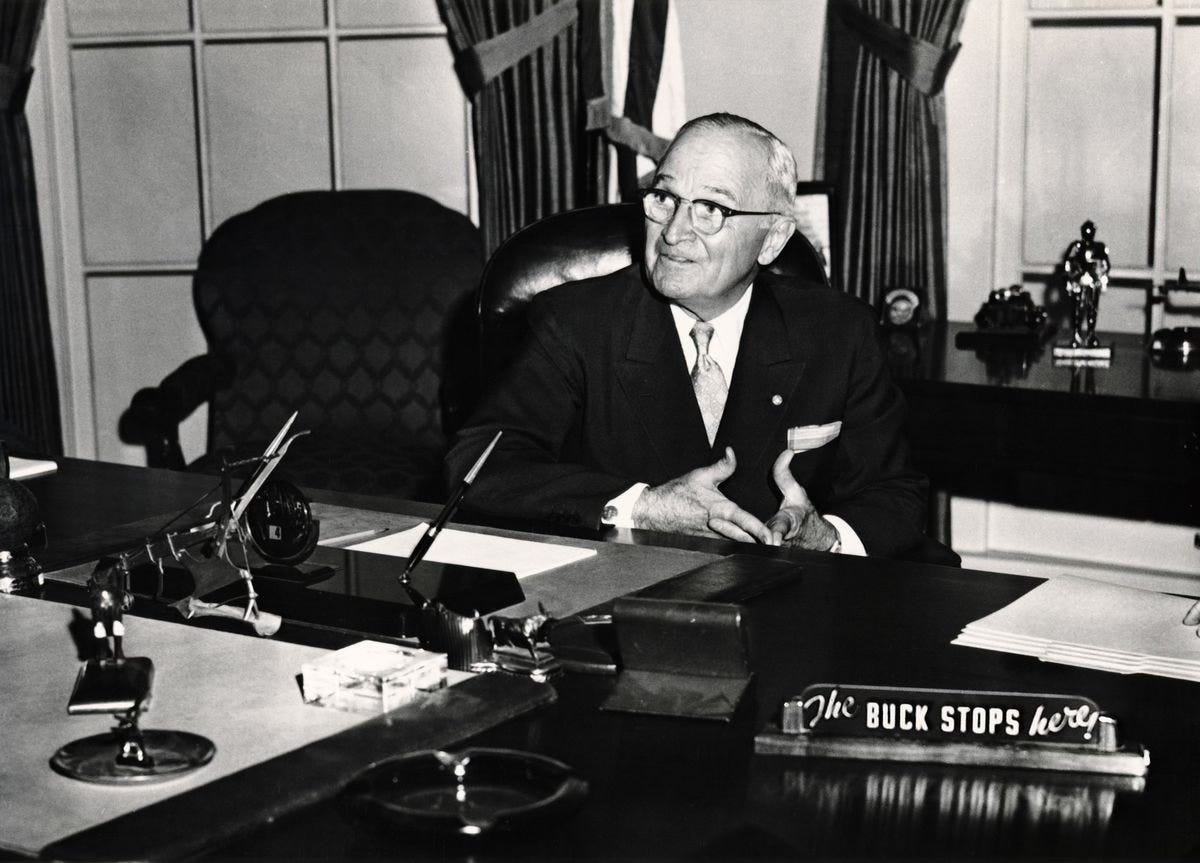
What wouldn’t we give for a president who doesn’t blame every problem on somebody else? (Truman Library photo)
When somebody behaves badly — treating a waiter rudely, say, or cutting in an airport line — I’m reminded of the reaction that sort of thing would draw from a guy I used to work for. “You have to wonder what their parents did to them to make them act that way,” my boss would say, with a shake of his head and the hint of a sad smile.
He was only half-serious, of course. Parents may lay the foundation for the way their offspring turn out, but both society and the law generally expect adults to be responsible for their own behavior. Even though people may carry insecurities from childhood all their lives — manifesting as anger, aggression or social withdrawal, say — there comes a point where we all need to take ownership of our emotions and actions. It’s an expectation of adulthood.
But not for everyone, apparently. One of Donald Trump’s most malignant characteristics is his persistent refusal to take responsibility for what he does. It’s a personality trait that has mutated into political and governmental policy, so that now nobody in the president’s often-shifting good graces is truly held to account for anything. When bad news surfaces, it’s somebody else’s fault; when it’s time to make good on promises, there’s no better moment to distract by defiling almost anybody handy, often on an unrelated point.
Nobody shimmies and shifts as masterfully as Trump, but a good show of it was made this week by Attorney General Pam Bondi, in her first appearance before the House Judiciary Committee. Members of Congress asked Bondi about the Justice Department’s dubiously lawful handling of immigration cases, about its prosecution of Trump’s perceived enemies — which grand juries and judges have rebuffed — and, most expansively, about the DOJ’s handling of cases and files connected to the late sex offender Jeffrey Epstein. Bondi, who was a lawyer for Trump when he faced impeachment in 2020 and then got some lucrative lobbying work, dodged and weaved, usually by attacking her questioners or shifting to praise of Trump.
She called Rep. Thomas Massie (R-Ky.) “a failed politician,” told Rep. Jamie Raskin (D-Md.) he was “a washed-up loser lawyer” and outrageously accused Rep. Becca Balint (D-Vt.), who lost her grandfather in the Holocaust, of being antisemitic. When Rep. Jerry Nadler (D-N.Y.) asked a question about Epstein, she ignored the topic and instead lauded Trump for the Dow Jones Industrial Average.1
You’d have to say that in the decade since she endorsed Trump’s first presidential bid as Florida’s attorney general, Bondi certainly has learned her place. Now holding a position that its previous occupants proudly guarded as independent from the White House, Bondi revealed herself to be as subservient to her president as Epstein’s underaged victims surely were forced to be to the financier.
But Bondi, of course, has a choice. She’s an adult. We have to view her complicity in the moral and policy debasement of Trumpism just as we judge that of other administration officials and compliant Republican members of Congress: There’s nobody to blame for this self-abnegation than themselves.
To my old boss’s tongue-in-cheek point, you certainly can’t blame their parents. They’re all old enough to know better, and do better. Actually, it’s pretty clear Pam Bondi should have paid more attention to her father. There’s a lot she might have learned from him.
A concept called “locus of control” is used by psychologists to assess the sense of agency a person feels about his or her own life. That is, people with an internal locus of control believe that their actions matter, and that they are largely the masters of their own destiny; people with an external locus of control figure that other factors — such as the actions of other people or the accident of their birth — are more to blame for what happens to them.
It’s a continuum, of course, as it is with most ways we measure personality: Nobody is either entirely manipulated by others or fully self-made. While some experts believe there’s a genetic element to locus of control — that people are born with a more internal or external sense of how things happen — there’s a stronger argument that it’s learned and internalized, and that individuals’ childhood experiences are the first step in determining how they view their own capacity and responsibility for what happens to them. Indeed, internal locus of control, that sense of self-responsibility for one’s behavior and outcome, is identified a mark of maturity.2
Since the concept was introduced by the American psychologist Julian B. Rotter in 1954, many studies have suggested that people with an internal locus of control are generally more successful, healthier and happier. So educational theorists for years have tried to figure out how schools can best help kids develop that self-regulated sense of responsibility. Joseph Bondi, who was for decades an education professor at the University of South Florida, was particularly engaged with the concept of locus of control.
Bondi was a foundational figure in the American middle school movement, which began in the 1960s. His argument was that 11- to 14-year-olds needed a unique school environment that explicitly taught that they have power over their choices, and that their choices have consequences. Over the course of two decades starting in the late 1970s, Bondi published two dozen books and numerous articles, many of them identifying ways schools could teach self-management skills, so students could take control of their thinking, learning and behavior.3
Joseph Bondi and his wife had the first of their three children, Pam, in 1965. She was 5 years old when her father was elected to the City Council in Temple Terrace, a Tampa suburb. From 1974 to 1978, the professor was also the community’s mayor. It was a period of growth when the municipal government built a new library, recreation center, police headquarters and city hall.4 An insightful article by Stephanie McCrummen in the current edition of The Atlantic describes the elder Bondi as “an FDR Democrat.” (Pam Bondi was registered as a Democrat from 1984 until 2000; the St. Petersburg Times reported in 2010, when she first ran for state attorney general, that she “could not recall why she became a Republican when she did.”)5
It’s unlikely, of course, that the theorist of education who pushed schools to teach students about their personal power over their own actions and choices wouldn’t have tried to imbue that same notion in his daughter. But Joseph Bondi couldn’t have imagined his daughter would run into Fred Trump’s son.
Many biographers have noted that Donald Trump’s ruthless ethic — described efficiently by biographer Gwenda Blair as “compete, win, be a killer” — was learned from his father, who launched the family real estate business. Tony Schwartz, co-author with Trump of The Art of The Deal, said that Fred Trump was “a very brutal guy,” and that in trying to please his father, Donald Trump learned the behavior that he came to expect in others.
It’s precisely that kind of a family environment that pushes youngsters toward a predominantly external locus of control. That is, children of authoritarian parents tend to believe that their actions do not dictate outcomes, leading to a sense that life is controlled by outside forces. No wonder, then, that Donald Trump is ever eager to blame others for whatever seems uncomfortable to tolerate. Nothing could possibly be his fault; people are always doing things to stymie him.
Trump’s targets are numerous: Joe Biden and Barack Obama, of course, but also economists, climate scientists, “radical left lunatics,” China, immigrants, the “deep state,” European allies, Democratic governors, members of Congress and, certainly, the “fake news” media.6
Those sorts of attacks are these days being echoed by Republican officials eager to copy the success of their leader and win his backing, hoping it may last for a while. You hear it in JD Vance’s belittling of our European allies, in Kristi Noem’s rhetoric about immigrants, and in the shifting of blame that Pam Bondi threw around during the Judiciary Committee hearing this week. But if Bondi has sacrificed her self-direction to please Donald Trump, she is far from alone: A tragedy of the Trump era in American politics is the number of seemingly capable people whose independence and judgment have been obviously hobbled by their obeisance to a corrupt leader.
How far we have strayed, sadly, from the concept of the presidency embraced by most of those who occupied the Oval Office before Trump. Take, for instance, Harry Truman, who famously sat at the aptly-named Resolute Desk behind a sign reading, “The buck stops here.” In his farewell address, Truman said, “The president, whoever he is, has to decide. He can’t pass the buck.” Truman did not shirk tough choices, or blame others for them, including even his most consequential and controversial decision: to use the atomic bomb.
But the self-confidence that allowed Truman to shoulder responsibility wasn’t based on inflated ego, nor did his decisiveness lack humility. When his term in office expired, the ex-president and his wife, Bess, boarded a commercial train and rode it back to Independence, Mo., with other passengers. Later that year, they bought a new 1953 Chrysler New Yorker and drove it by themselves to New York and Washington, D.C., and then back home again. (Note that they didn’t take advantage of the bribe of a fancy aircraft from a foreign country.)7
But just as Trump’s presidency has changed his office, so it might change the people of America unless we work to keep our wits about us. That is, we can’t let ourselves slip into thinking that we have lost control, or that events have left the nation beyond our capacity to change it. We need to assert a sort of internal locus of control for both ourselves individually and our society.
Donald Trump is clearly to blame for many acts that are nearly intolerable. Here are a quick half-dozen: The brutal treatment of immigrants and citizens alike by masked federal agents. The grossly irresponsible abandonment of the fight against climate change. The reckless economic policies that seem likely to hobble our grandchildren’s financial security. The effort to curtail voting rights and skew elections to protect an increasingly radicalized Republican party. The heartless withdrawal of life-saving aid from some of the poorest corners of the earth. The careless betrayal of our allies, both in the Americas and in Europe, in the service of a worldview that accepts raw power as more useful than human care.
Terrible as those are — and you can add more offenses against our democracy, of course — we cannot blame the nation’s decline on Trump, or anybody else, if we don’t recognize that its future is really in our hands. It’s a mid-term election year, a time to demonstrate, donate, organize and vote — that is, to put in the work that can begin to turn America away from Trumpism. The future is ours to control.
It’s destructive to both ourselves and to the country’s future if we allow ourselves to be Trump’s victims. If we did that, you’d have to wonder what our parents did to us to make us think wallowing in self-pity was the best we could do.
https://thehill.com/homenews/house/5734303-pam-bondi-judiciary-committee-hearing-epstein/
https://www.psychologytoday.com/us/basics/locus-of-control#:~:text=Locus%20of%20control%20refers%20to,to%20his%20or%20her%20life.
https://scholarworks.uni.edu/cgi/viewcontent.cgi?article=3236&context=grp#:~:text=Its%20development%20was%20primarily%20to,and%20characteristics%20of%20emerging%20adolescents.
https://www.tampabay.com/archive/2013/01/10/mayor-educator-textbook-writer/
https://web.archive.org/web/20100716180503/http://www.tampabay.com/news/politics/elections/gop-attorney-general-candidate-pam-bondi-has-democratic-roots/1108648
https://thehill.com/opinion/white-house/5668530-trump-blames-others-failures/
https://www.cbsnews.com/news/did-you-know-leaving-the-white-house/
Note: Comments on The Upstate American’s website are open to paying subscribers. We are grateful to all our readers, and invite you to join in supporting this work.
WHY NOT TELL YOUR TRUTH?
LEARN TO WRITE OP-EDS — FOR PRINT, AUDIO AND PODCASTS
If you’d like some training in writing opinion essays — for newspapers, audio or digital platforms — check out the live 90-minute class Rex co-teaches that is offered by Marion Roach Smith’s global platform for writing instruction, The Memoir Project. Click below for information on our upcoming schedule of classes.
Our next class is WEDNESDAY, FEB. 18 at 5:30 p.m. Eastern.
Will you join us?
Lots of our students have been well published — and you can be, too!
BONUS CONTENT
GET MORE FROM THE UPSTATE AMERICAN
IF YOU’D LIKE TO HEAR MORE from Rex Smith, check www.wamc.org for his weekly on-air commentary aired by Northeast Public Radio. Here’s a link to the latest essay.
AND IF YOUR INTEREST IS SPECIFIC TO AMERICAN MEDIA, you can download the podcast of The Media Project, the 30-minute nationally-syndicated discussion that Rex leads each week on current issues in journalism. In the seven states where Northeast Public Radio is heard, the program airs at 3 p.m. each Friday and is rebroadcast at 6 p.m. Sunday. You can tune in live, too, at www.wamc.org, or download the podcast there. It has been called “a half-hour of talk about finding and telling the truth.”
ENDNOTE
THANK YOU FOR JOINING US THIS WEEK
THE UPSTATE AMERICAN is a weekly essay aimed at helping all of us who are concerned about America’s future consider how we might best respond to the challenges of the day. Thank you for joining in the conversation about our common ground, this great country. I hope you’ll be back next week.
And don’t hesitate to send your thoughts, especially with ideas that you think we all ought to be considering.
-REX SMITH
Interesting that you mention locus of control. When I taught science to pregnant and parenting teen girls, I rarely had a student who blamed someone else for their pregnancy. Aside from the rare case of rape, students accepted they were at least partially responsible for their pregnancy. If only our president had the maturity of a 15-year-old teen mom.
I am personally enjoying the way the new pope telegraphs that everyone, but especially the president, could and should behave better. Just this morning, I see the pope has asked that for Lent, people control their own hate speech. Of course, the pope said it much more kindly and elegantly.🙂