
Waging war by putting on a show
If it's not mostly showbiz, why would Pete Hegseth care so much about his picture?

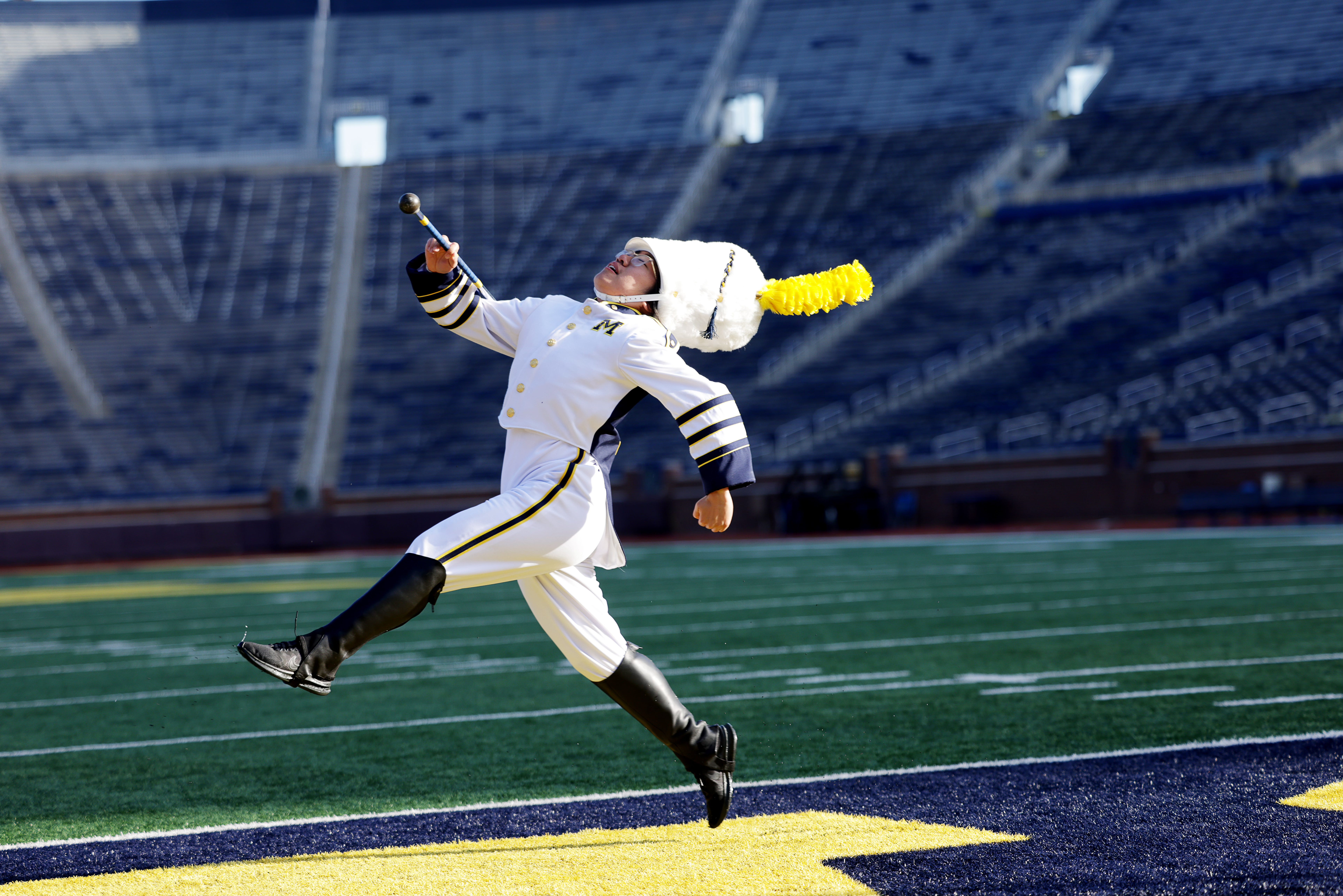
Sometimes you have to know how to put on a show. But there’s more to governing than that. (Photo by Brenda Ahearn/University of Michigan)
Probably this bit of personal history is relevant: I was the drum major of my high school marching band, a proud group that had finished near the top in national competition the year before I got to wear the big hat (which, by the way, is called a busby). To prepare for this role, 15-year-old me went to a summer drum major camp at a big university in the west. The drum major I was to understudy for a year explained, “You’ve got to learn some struts.”
And I did. At the start of a halftime show, I would kick my legs straight ahead, lean far back and bound ahead of the band from the goal line, brandishing a big baton. To turn left, I would first flip to the right in order to make a showy 270-degree turn. I could whip the baton around from my waist to above my head, and when I directed the band, my beats were exaggerated and stylized. Every move I made was fashioned to draw notice.
So I know a good strut when I see one. Which brings me to Pete Hegseth, leader of the most powerful military force ever assembled on earth. I tell you, people, the man can strut.
When I think of Hegseth, he of the tomahawk jaw and red-white-and-blue pocket square, I picture the video of him stalking back and forth across a stage last fall in front of hundreds of generals and admirals who had been summoned to Quantico, Va., from around the world, so that Hegseth could assert his philosophy of military preparedness. “No more identity months, D.E.I. offices, dudes in dresses,” he declared. “No more climate change worship.” He already had fired commanders who were black and female, or in some cases both. It was time, he said, for everybody associated with the U.S. military to be fierce and ruthless, and only that.1
As he said all that, Hegseth literally strutted in front of the brass who now were under his control. Sure, he had learned the basics of precision drill as a Princeton ROTC cadet, but there was more than a touch of the thespian in the pivots and squared shoulders he displayed on the stage that day.
That tough talk makes it surprising to note Hegseth’s obvious fragility. This week he apparently flipped out when news outlets published what Hegseth considered to be unflattering photographs of himself at a Pentagon lectern. He promptly barred photographers from his press briefings. Who knew that this flinty fellow might be so easily upset?2
It’s not clear exactly what about the photos so disturbed Hegseth. Was he squinting? Did the angle of the photos fail to conceal an emerging second chin on the uber-fit 45-year-old father of seven? (That includes three kids his third wife had with another guy.) You know, a fixation on one’s personal appearance — and what, other than self-fixation, could prompt such pique? — is more the stuff of someone in show business than in government service.
Why yes, of course! This bellicose Secretary of War, the title his boss has affixed, came from a background unlike any of his predecessors. Only a year and a half ago, Hegseth’s aspiration might have been to get promoted to a weekday show on Fox News instead of languishing, as he was then, in a role as a commentator on weekend programs. I can sympathize with that, because I know what it’s like to be second string; it’s kind of the way I felt as the junior drum major, before they put the big baton in my hands.
But, to be clear, I was 15 years old then. You expect somebody in a role like Hegseth’s to have enough self-confidence to focus on what matters, and photogenicity is not what you think would matter so much to someone who is leading a war effort that has so far hit 5,500 targets in Iran at a cost to American taxpayers of $11 billion, growing at a rate of about $890 million a day.3
But what if the man at the helm of the Pentagon thinks, down deep, that his job is really pretty much showbiz? You almost can’t blame him. There’s a lot of that sort of thinking going around.
Politics has always been theatrical at some level. The revolutionary patriot Patrick Henry is now remembered mainly for his 1775 “give me liberty or give me death” speech, which he delivered to the Virginia House of Burgesses with an actor’s swagger, including stage gestures mimicking handcuffs and a dagger. Candidates routinely sample food at county fairs and sit for trims in barbershops not because they’re hungry or need haircuts, but because they hope such play-acting will make them relatable to their constituents.
Sometimes, of course, the performative aspect of politics is what powers it forward. Demonstrations in the streets drew attention to the civil rights and antiwar movements of the 1960s, highlighting the issues of inequality and toxic colonialism. Public demonstration of that sort remains vital today — including the No Kings rallies that are expected to draw millions of people nationwide later this month. Big public events can inspire, unify and motivate people to action.
That’s different, by the way, from the attack on the Capitol of Jan. 6, 2021. The Trump partisans that day weren’t just demonstrating their solidarity with the President; they were on a mission to stop the electoral process in its tracks, even if it required attacking cops and hanging the Vice President. Ignorant, malevolent and misdirected as many of them indeed were, they were out to change things, not just put on a show.
But there’s an emerging sense that many politicians — even, maybe, most of them in federal office in the Trump era — have come to see their jobs as being more about symbolic gestures than substantive change. Our system often seems to reward spectacle, with its immediate impact, over accomplishment, which tends to both take time and diffuse credit.
This is most obvious in Congress, where ideological purity and public visibility have become the currency of success. You can blame the Supreme Court for some of this: By declaring partisan gerrymandering perfectly acceptable under our Constitution, the Court has locked in 90 percent of congressional districts as noncompetitive between the two major parties. On a practical level, then, a representative’s best chance of re-election comes from satisfying only the small percentage of voters who participate in primaries. No wonder the authoritative Cook Political Report released this week rated only 17 House races out of 435 on the ballot in November as “toss up,” and another 19 as “leaning” one way or another.4
Rigid adherence to ideology thrills partisans. So for many politicians, there’s more success to be found in keeping a problem alive than in solving it — that is, if success is defined as mobilizing a political base and raising money, which are the dynamics that win elections. It is mostly political careerism, then, that gives rise to politics as spectacle.
Also key to this dynamic is the decades-long decline in fact-based journalism. Last year, social media and video applications for the first time displaced television as the main information source for voters — with online news sites, podcasts, radio and print lagging behind. On social media, the subset of influencers have found that political engagement can be a vehicle for personal branding. 5
No wonder the 2024 presidential candidates courted influencers: Around the time of the last election, one-fifth of Americans said that’s where they regularly get news. Since influencers’ success is based on their reach, their views often tend to be provocative. And that carries them even further, because their excesses are amplified when they’re reported by mainstream news outlets.
“So long as you subscribe to the appropriate views and defend them with sufficient vigor, you can rest safe as a member in good standing of your chosen political tribe,” the thoughtful Republican political writer Brink Lindsey declared three years ago, in an article for the Niskanen Center. “Assuming any responsibility for actually moving public policy into closer accord with those appropriate views isn’t necessary; on the contrary, doing so can actually be hazardous to the effective maintenance of your tribal identity.”6
That is, taking a stand has come to matter more than achieving an outcome. It is an unsettling reality of American politics, and one that won’t change until voters shut down the shows being staged by the worst producers of such cynical political theater.
Plenty of people with qualifications beyond mine in international affairs have in recent days raised the question of what Donald Trump is actually trying to accomplish in the war he launched on Iran. Will combat continue until a new regime is in power in Tehran, even if that requires, as many experts insist it would, a commitment of ground troops, which the American people oppose? Will he be satisfied if he can claim that Iran’s missile capabilities and its nuclear development are destroyed? Or maybe the president will pull back sooner, perhaps in order to bring down gasoline prices, or to free up shipments of fertilizer now held up by the closure of the Strait of Hormuz, which American farmers will need for spring planting. We just don’t know.7
The lack of specific objectives leads to the sense that perhaps the whole conflict is part of an ongoing demonstration of Trump’s philosophy that the only currency that matters in this world is force. After all, the kidnapping of Venezuela’s president and the blowing up of at least 46 vessels in the Pacific Ocean and Caribbean Sea since September, leading to 157 deaths, had less to do with stopping drug trafficking than with asserting American control over the hemisphere. Likewise, the deployment of federal troops and immigration agents to the streets of American cities clearly isn’t aimed as much at arresting criminal immigrants — there aren’t that many of them, you know — as it is at showing force to underscore Trump’s dominance.
You can find similar examples of Trump’s tendency to behave as a reality show star in almost every aspect of government. The resurgence of attention to Jeffrey Epstein years after his death was provoked by Trump himself, not because of horror at Epstein’s crimes but as a supposed example of a deep state cover-up. And the White House push to enact a law requiring voters to prove citizenship isn’t about safeguarding democracy; it’s about making it harder for poor people to vote, under the pretense that undocumented immigrants are taking over our political system — a provably false notion.
The president, it is clear, is a great pretender.
In light of Trump’s own penchant for performative politics, then, you might feel a bit of sympathy for Kristi Noem, who has the distinction of being the first cabinet officer fired in this Trump term. What finally moved Trump to oust her was a performance that went just a bit too far: an expensive video of Noem on horseback in the shadow of Mount Rushmore, which was so self-promotional as to finally have stepped over some line that Noem had failed to recognize. You could have seen that coming, though; a woman who thought it was a good idea to brag about shooting the family dog, Cricket, is not someone who will notice when her performance has gotten grating on her audience.8
So the Secretary of War, adept as he is at the artifice of bold leadership, needs to be careful. He is skilled, indeed, at the task of reading lines convincingly when they’re served up on a teleprompter under the spotlights and LED panels of the Pentagon stage. Yes, the man can strut. But Pete Hegseth has to know that this show has only one actor in a lead role, and you never really know how this star will want things to play out.
https://www.nytimes.com/2025/10/07/opinion/pete-hegseth-speech-dei.html
https://www.washingtonpost.com/business/2026/03/11/hegseth-press-briefings-photos-iran/
https://www.csis.org/analysis/37-billion-estimated-cost-epic-furys-first-100-hours#:~:text=As%20laid%20out%20in%20Figure,complete%2C%20according%20to%20General%20Caine.
https://www.cookpolitical.com/ratings/house-race-ratings
https://www.niemanlab.org/2025/06/for-the-first-time-social-media-overtakes-tv-as-americans-top-news-source/
https://www.niskanencenter.org/the-performative-turn/#:~:text=Beyond%20the%20dwindling%20political%20resources,status%20of%20clashing%20political%20identities.
https://www.nbcnews.com/politics/trump-administration/trump-administration-iran-statements-rcna263243
https://www.theatlantic.com/ideas/2026/03/kristi-noem-fired/686251/
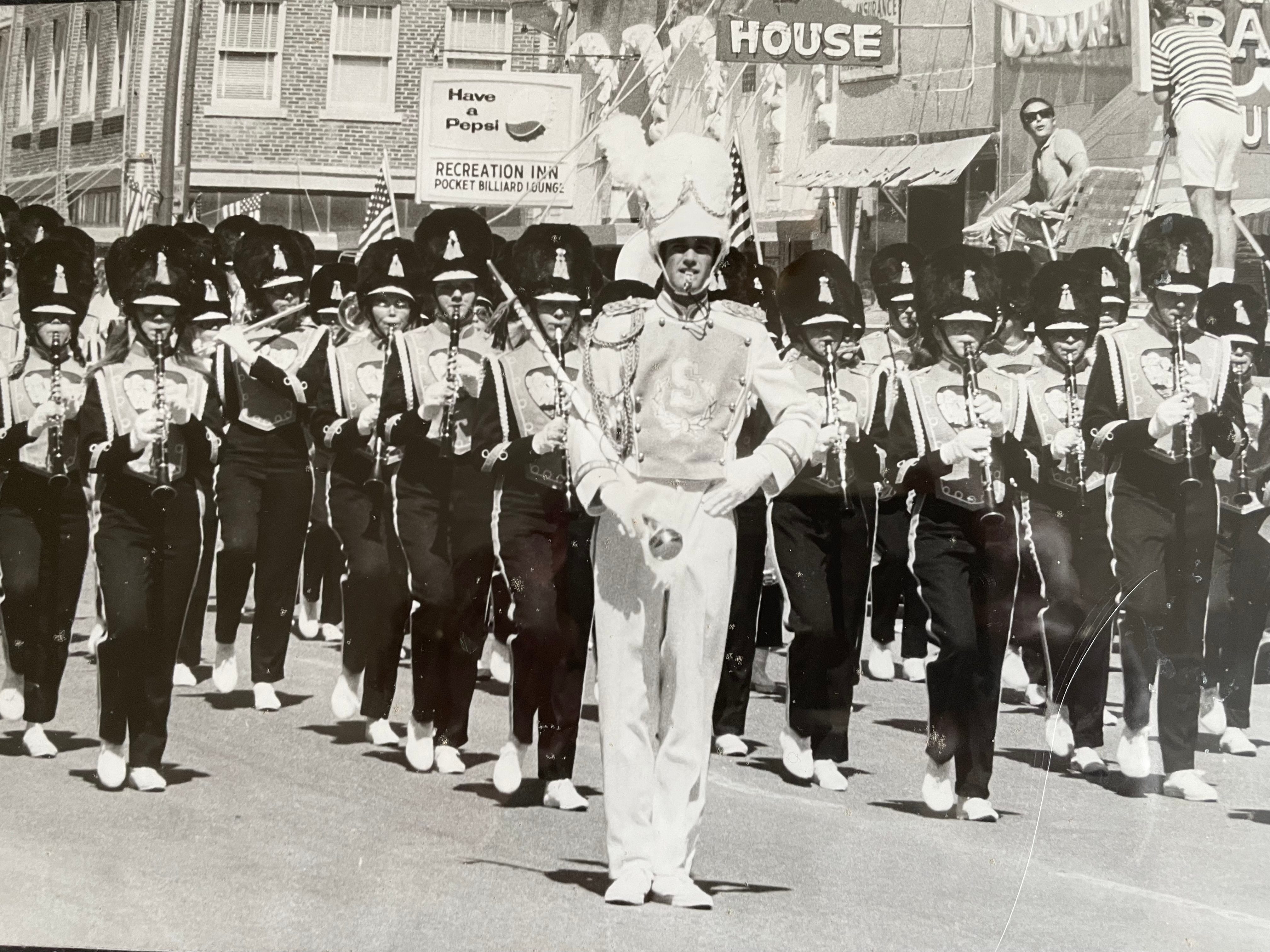
Yes, it’s me: Leading The Big Blue Band, a/k/a the Raider Marching 100, in Rapid City, S.D., in 1970. (Rapid City Journal photo by Don Polovich)
WHY NOT TELL YOUR TRUTH?
LEARN TO WRITE OP-EDS — FOR PRINT, AUDIO AND PODCASTS
If you’d like some training in writing opinion essays — for newspapers, audio or digital platforms — check out the live 90-minute class Rex co-teaches that is offered by Marion Roach Smith’s global platform for writing instruction, The Memoir Project. Click below for information on our upcoming schedule of classes.
Our next class is MONDAY, MARCH 23, at 6 p.m. Eastern.
Lots of our students have been well published — and you can be, too!
BONUS CONTENT
GET MORE FROM THE UPSTATE AMERICAN
IF YOU’D LIKE TO HEAR MORE from Rex Smith — specifically, his take on current issues in American journalism — you can download the podcast of The Media Project, the 30-minute nationally-syndicated discussion that Rex leads each week with other veteran editors. In the seven states where Northeast Public Radio is heard, the program airs at 3 p.m. Eastern each Friday and is rebroadcast at 6 p.m. Sunday. You can tune in live, too, at www.wamc.org. It has been called “a half-hour of talk about finding and telling the truth.”
ENDNOTE
THANK YOU FOR JOINING US THIS WEEK
THE UPSTATE AMERICAN is a weekly essay aimed at helping all of us who are concerned about America’s future consider how we might best respond to the challenges of the day. Thank you for joining in the conversation about our common ground, this great country. I hope you’ll be back next week.
And don’t hesitate to send your thoughts, especially with ideas that you think we all ought to be considering.
-REX SMITH
Senator Patty Murray of Washington is a good example of a senator who works at solving problems and doesn’t really have a performative bone.
"The only people who are mad at you for speaking the truth are those who are living a lie." - Frida Kahlo