
We are not an island
Today's challenges, including a war of choice, reveal our interconnectedness.

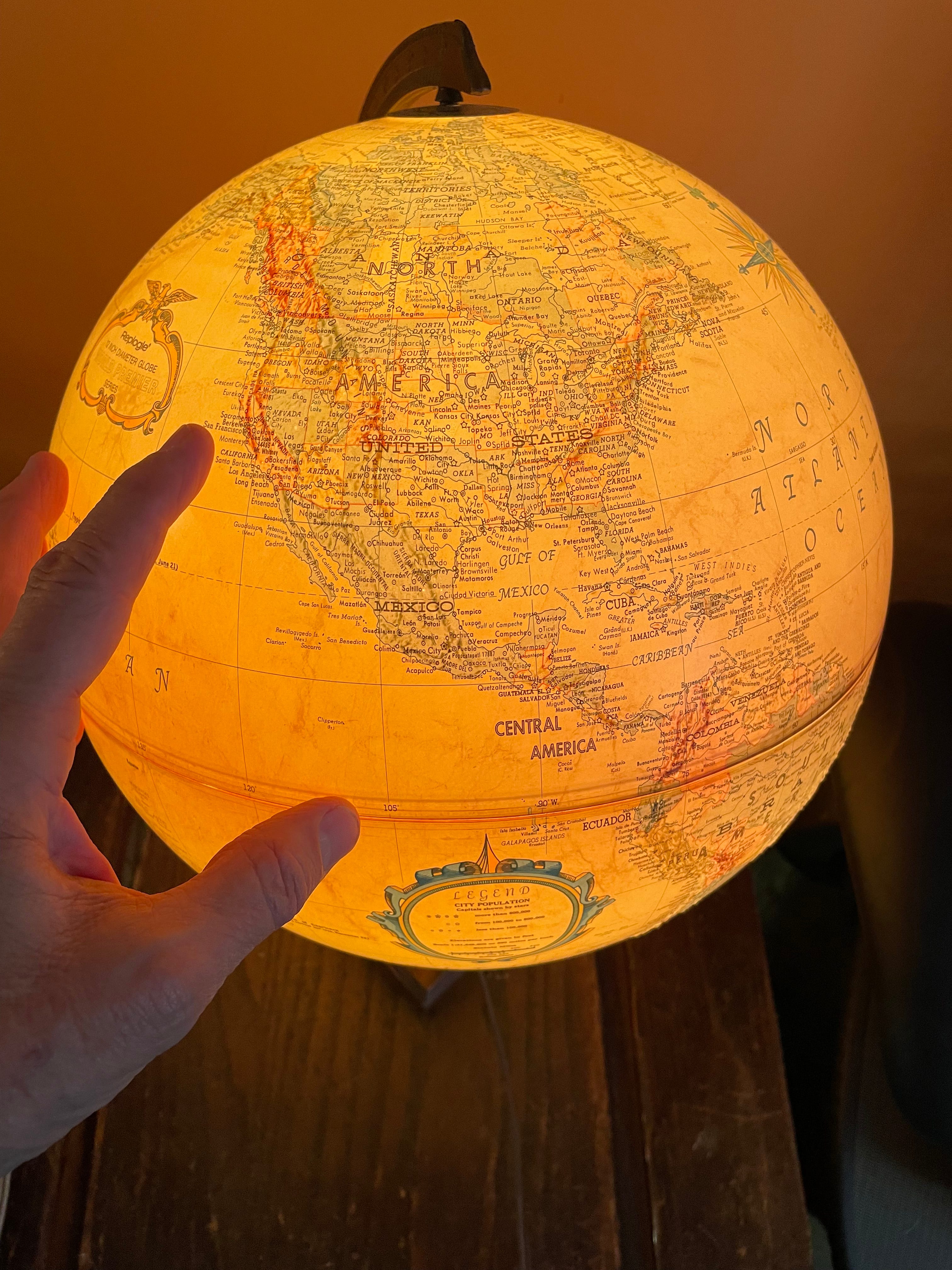
How we wish for a president who studied geography — or history or literature.
You cannot balance an egg on its end at the vernal equinox, it turns out, at least not any more easily than on any other day. But you can take note of the first emerging buds of the season, which is what my wife and I were doing, gratefully, at the mid-morning moment of astronomical spring’s arrival this year. It remains a cold season Upstate, though, with temperatures predicted to drop below freezing most nights for the next couple of weeks.
Out West, it’s another story: There’s an historic heatwave, with four places in Arizona and California hitting 112 degrees Fahrenheit on the first day of spring, making it the hottest March day in recorded U.S. history. Some communities near Denver have already declared a Stage 1 drought emergency and imposed limits on water use. Experts warn that it’s likely to be a tough summer in the mountains. The advance of climate change is relentless.1
Of course, a functioning government with its citizens’ best interests at heart would be taking action. But the administration of Donald Trump is instead doubling down on the environmentally destructive path humanity has taken since the Industrial Revolution. More thoughtful leaders around the world have worked in recent years to reverse that, but in this winter of 2026, Trump’s regime has made it clear that Americans should be free to dirty up the earth’s air and water to our hearts’ content — by acting to remove the government’s power to regulate climate-damaging greenhouse gases, to weaken vehicle emission standards, to promote fossil fuel production, to block offshore wind energy projects and to withdraw from international climate agreements.2
Trump’s move to make the United States an outlier in the fight against climate change is just one element of our nation’s growing isolation and indifference. Millions of Africans will be at risk of death due to U.S. aid cuts; the president’s threats to places as disparate as Greenland and Cuba have upended notions of international cooperation and national independence; the global economy has been disrupted by the capricious application of tariffs, which Trump continues to insist he will impose in violation of international agreements and, according to the Supreme Court, the U.S. Constitution.
America these days consistently obstructs the legitimate needs and concerns of other nations. No wonder Americans are increasingly viewed as international hooligans. We are associated with almost daily displays of breathtaking contempt for the interconnectedness of all 8.3 billion of us on this small planet.
So we shouldn’t have been surprised that Trump plunged our nation into war in the Mideast without the support of allies, with no plan for ending the conflict and no apparent concern for dealing with its tragic impact. We do not know the war’s likely direct cost to taxpayers, nor do we have a sense of how the world will deal with the economic upheaval it is already causing. More broadly, we can’t imagine how our nation will cope with the likelihood that people in the Mideast for generations to come will have even deeper and broader enmity toward the United States because of what is going on right now.
We should know by now that Donald Trump recognizes responsibility for nothing in the world but the superficial achievements that he imagines might satisfy his bottomless craving for attention and glory. Maybe what he needs in his newly-gilded Oval Office — beyond the ten flags he has ordered displayed behind the Resolute Desk, the 20 portraits he has chosen to cover the walls, the nine 19th-century gold trophies he has placed on the mantle and the many ornate appliqués affixed to the walls — is something that signifies not just wealth and power, which he obviously covets and adores, but rather the stakes that attach to a president’s decisions. Maybe he needs a globe.
The first globe, created in the second century B.C.E. by the Greek philosopher Crates of Mallus, portrayed four continents divided by rivers and oceans. The oldest globe that still exists today was built in the same year that Christopher Columbus first sailed across the ocean, by a German cartographer, Martin Behaim. It does not show the Americas at all.3
Over centuries, globes were used as navigation and learning tools, but they also were often exchanged as gifts among important rulers — as though signifying command of the known world. President Franklin D. Roosevelt kept a massive globe more than four feet in diameter, and weighing 750 pounds, just behind the Resolute Desk, and he presented identical models to Winston Churchill and Gen. George C. Marshall. The globes were built for the wartime leaders by the Office of Strategic Services (OSS), the predecessor of today’s CIA, whose chief cartographer said that the globe’s dimension “helped them contemplate the immense strategic and logistical problems of a truly global conflict.”4
Today, of course, in the era of Google Earth and satellite surveillance, globes are mostly used for décor. And since international boundaries are often in flux, any model of earth is bound to be out of date almost as soon as it is created. But in presenting the world as astronauts have described viewing it from space, a globe imparts a sense of both the breadth of the earth and the interconnectedness of its inhabitants: We’re all here, struggling along, on this one little sphere.
It is a concept that has inspired humility in many leaders. Barack Obama — who once said that a major task of the presidency was “to constantly remind us of the ties that bind us together” — alluded to America’s awesome global responsibilities and the importance of restraint in a speech at the United Nations in 2014. Calling on nations to combat both imperialist aggression and the spread of violent extremism, he said, “No nation can subjugate its neighbors and claim their territory.”
Obama warned that “the cause of empire leads to the graveyard,” and vowed that the United States would never “act as an occupying power.” Rather than “might makes right,” he said then, America would pursue the view of “right makes might.”5
But Obama’s view was clearly renounced by his successor. Throughout his first term, and in the first 14 months of his second, Trump’s pursuit of his “America First” philosophy has led to the alienation of allies and the sense that the world’s only superpower is no longer bound by international laws, treaties or understandings. Indeed, in January, Trump told The New York Times that he didn’t “need” international law. Asked if there are any limits on his global power, he replied, “Yeah, there is one thing: my own morality. My own mind. It’s the only thing that can stop me.”6
And in an interview this month with The Wall Street Journal, Trump claimed a similar criterion for a decision on when the war he started with Iran will end. “When I feel it — feel it in my bones,” he said.7
It is both an astonishing assertion of power and a chilling reminder of the world’s vulnerability to the whims of a man whose behavior has often raised questions about his mental capacity. And it is a refutation of the underlying principles that led to the establishment of the United States.
The nation’s founders were students of the Enlightenment, an 18th-century intellectual movement that focused on the power of reason and the equality of all people. If its precepts weren’t fully embraced by Thomas Jefferson and his contemporaries — many of them were slaveholders, after all — there was certainly a sense in 1776 and the years that followed that might alone was not the means for advancing a nation’s interests, and that it was the consent of the governed, not inherent power, that gave leaders their authority.8
While America hasn’t always benefited from enlightened leadership, it has never before been in the hands of someone who so eagerly argues that he alone holds power over its actions and over how it deals with the rest of the world. If he weren’t so detestable a human, you might feel some sympathy for the deep loneliness that must affix to Donald Trump.
In the days since America’s attack on Iran, many of us have concluded that America will struggle for years to come to regain its standing as a champion of what’s right. Perhaps that explains why, during my dawn walk with my pup Roscoe a few hours before spring’s official arrival, I was humming a hymn-like verse I learned as a child that is derived from a verse in John Donne’s Devotions Upon Emergent Occasions. It’s usually referred to as Donne’s “No man is an island” work.
Donne, an English cleric and poet born in 1572, had an impact on the ideas that fed into the Enlightenment. While his views were pre-Enlightenment, he seemed to embrace the questioning spirit that came to define the world that would emerge two centuries later. The words of his that are perhaps best remembered today were written in 1623:
No man is an island,
Entire of itself,
Every man is a piece of the continent,
A part of the main.
If a clod be washed away by the sea,
Europe is the less.
As well as if a promontory were.
As well as if a manor of thy friend’s
Or of thine own were:
Any man’s death diminishes me,
Because I am involved in mankind,
And therefore never send to know for whom the bell tolls;
It tolls for thee.
Surely young Donald Trump would have encountered Donne at New York Military Academy, where his father sent him when he was an undisciplined 13-year-old, or at the University of Pennsylvania, which granted him an economics degree. It has often been said that Trump doesn’t read, but even if he read those words, he clearly couldn’t have taken much note.
After all, Donne’s notion of a deep, shared world community conflicts sharply with Trump’s nationalism. And the view of humanity as a “continent” where the loss of a single clod of dirt washes away part of the whole is quite unlike the Trumpian view of the world in transactional terms, with international relations an arena for competition rather than a collaborative community of nations.
A leader who was elected with a promise to build a wall at the border and implement tariffs to shut the American market from foreign goods, who embarks on war with little regard for its broad impact, clearly doesn’t understand the reality of today’s challenges. Climate change, migration, global trade — and, just now, the uncertainty of this war of choice — prove that no country can truly function as an island. We need one another.
The chill at the beginning of this spring is not just in the Upstate air, then. It is in the sense that America under Donald Trump, with the acquiescence of a cowardly Congress, is abandoning the principles that have guided it for 250 years. For America, the warmth will return only if its citizens lose no opportunity to fight to reclaim those principles — most especially, by reassuming the responsibility we share with our fellow inhabitants of this imperiled planet.
https://www.theatlantic.com/science/2026/03/west-heat-wave/686457/
https://www.opb.org/article/2026/02/12/trump-epa-revokes-scientific-finding-that-underpinned-us-fight-against-climate-change/#:~:text=by%2Dstep%20instructions.-,Trump’s%20EPA%20revokes%20scientific%20finding%20that%20underpinned%20US%20fight%20against,Grail%20of%20federal%20regulatory%20overreach.%E2%80%9D
https://www.whipplemuseum.cam.ac.uk/explore-whipple-collections/globes/brief-history-globes#:~:text=People%20have%20used%20globes%20to%20model%20the,items**%20*%20**Recording%20discoveries**%20*%20**Navigational%20instruction**
https://blogs.loc.gov/maps/2018/01/the-presidents-globe/
https://www.cfr.org/articles/president-obamas-un-speech-defending-world-order
https://www.nytimes.com/2026/01/08/us/politics/trump-interview-power-morality.html
https://truthout.org/articles/trump-says-war-in-iran-will-end-when-he-feels-it-in-his-bones/#:~:text=The%20president%20also%20expressed%20a,targets%20%E2%80%9Cjust%20for%20fun.%E2%80%9D&text=Truthout%20is%20a%20vital%20news,feel%20it%20in%20my%20bones.%E2%80%9D
https://www.army.mil/article/282389/impact_of_the_enlightenment_on_the_american_revolution#:~:text=As%20with%20most%20major%20events,be%20infringed%20upon%20by%20governments.
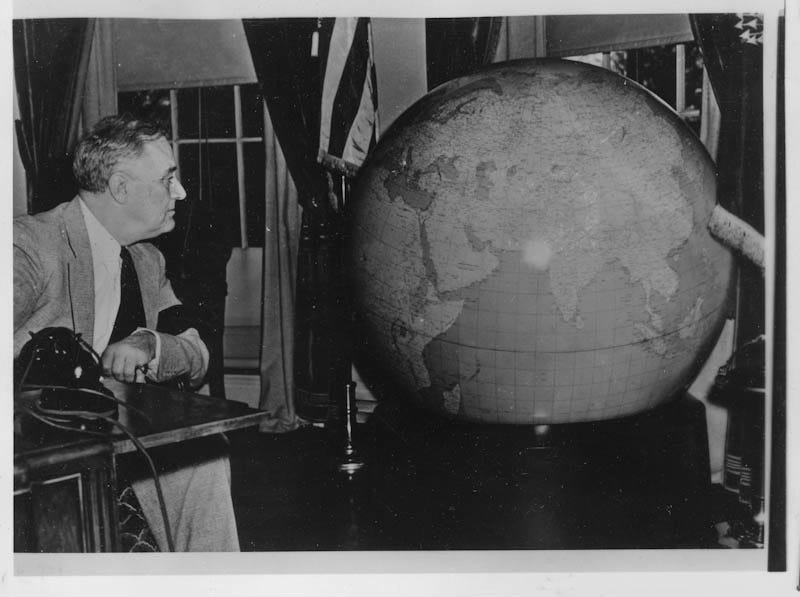
President Franklin D. Roosevelt is shown receiving the globe that he used in the Oval Office. The globe is now in the FDR Library and Museum in Hyde Park, N.Y
Comments on this Substack account are limited to paying subscribers. We invite you to join the community.
WHY NOT TELL YOUR TRUTH?
LEARN TO WRITE OP-EDS — FOR PRINT, AUDIO AND PODCASTS
If you’d like some training in writing opinion essays — for newspapers, audio or digital platforms — check out the live 90-minute class Rex co-teaches that is offered by Marion Roach Smith’s global platform for writing instruction, The Memoir Project. Click below for information on our upcoming schedule of classes.
Our next class is MONDAY, MARCH 23, at 6 p.m. Eastern.
Lots of our students have been well published — and you can be, too!
BONUS CONTENT
GET MORE FROM THE UPSTATE AMERICAN
IF YOU’D LIKE TO HEAR MORE from Rex Smith — specifically, his take on current issues in American journalism — you can download the podcast of The Media Project, the 30-minute nationally-syndicated discussion that Rex leads each week with other veteran editors. In the seven states where Northeast Public Radio is heard, the program airs at 3 p.m. Eastern each Friday and is rebroadcast at 6 p.m. Sunday. You can tune in live, too, at www.wamc.org. It has been called “a half-hour of talk about finding and telling the truth.”
ENDNOTE
THANK YOU FOR JOINING US THIS WEEK
THE UPSTATE AMERICAN is a weekly essay aimed at helping all of us who are concerned about America’s future consider how we might best respond to the challenges of the day. Thank you for joining in the conversation about our common ground, this great country. I hope you’ll be back next week.
And don’t hesitate to send your thoughts, especially with ideas that you think we all ought to be considering.
-REX SMITH
We are more connected than at any time in human history, and yet more lonely and isolated. At least many Americans are. It’s us, not them.